
If you've been keeping an eye out for big test transitions or gossiping about pro bikes lately, you've seen a label that's getting more and more repeated: “3D Printed.”
It appears in saddles with impossible geometries, in couplings that seem sculpted for a single athlete and in helmets that promise to be the squaring of the aerodynamic circle.
And, almost always, next to that label, we see a price that makes us raise our eyebrows.
The question is inevitable and many of you have sent it to us: are we facing a real revolution in performance or is it simply the latest marketing strategy to sell us more expensive material?
At Planeta Endurance we have immersed ourselves in this trend to tell you what is really there, what it means for you, the popular triathlete, and if it is really worth scratching your pocket.
What exactly is “3D printing” in our sport? Beyond the label
The first thing to understand is that “3D printing” is the colloquial term for what the industry calls additive manufacturing.
And the name says it all: instead of taking a block of material and removing what's left (like a sculptor with a block of marble), additive manufacturing builds the object layer by layer from a digital file.
Think about doing something with strips of papier-mâché instead of carving wood.
This paradigm shift is what makes us face a new situation: it frees designers from the shackles of traditional molds and allows them to create internal shapes and structures that were previously unthinkable or prohibitively expensive.
The advantages of lattice structure
The key to almost all of this new material is in the lattice structure. It is that kind of three-dimensional mesh or honeycomb that you see on the saddles and inside the helmets. It is not a simple padding; it is a programmable structure.
By varying the thickness and density of the filaments of that mesh, a manufacturer can make the tip of a saddle firm for stability, while the area of the ischia is soft to absorb impacts. All in one piece, without seams or changes in material that can cause chafing. This "zone tuning" is the holy grail that was sought with double or triple density foams, but brought to a level of price
Touchpoints: the battlefield where 3D printing wins the war
Triathlon is possibly the perfect sport for this technology. A road cyclist can afford a “near-perfect” fit.
A triathlete, no. We docked and stayed in that same position for hours, and then got off to run a half marathon. If something brushes against you, puts your hand to sleep or generates an unbearable pressure point in the last hour of cycling, you know perfectly well what we're talking about.
This is where 3D printing shines: it allows you to create specific solutions for individual problems.
As professional triathlete and material expert T.J. Tollakson discusses for Triathlete magazine, “If you can improve those details where the person meets the machine, you can usually improve both comfort and performance.”
Saddles: the spearhead of the revolution
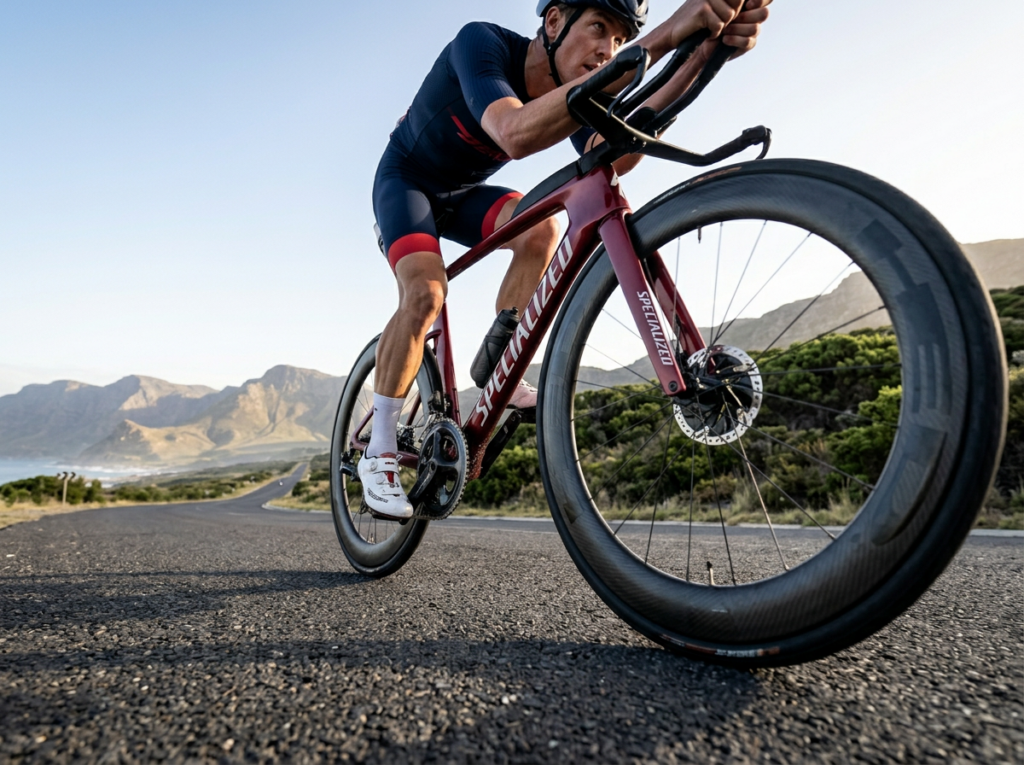
It is the most mature category and where the benefits are most evident. Brands such as Fizik (with its Adaptive line), Specialized or Selle Italia have massively adopted this technology.
The lattice structure replaces traditional foam, allowing previously impossible pressure management.
A good 3D saddle doesn't just feel 'soft', it feels controlled - it holds you where you need support and gives way where you need relief.
For many triathletes who struggle with numbness or discomfort over long distances, this has been a before and after.
Helmets: the next frontier of aerodynamics and comfort
Traditionally, in aero helmets you had to choose: either maximum speed (smooth, without ventilation) or good cooling (with large openings).
The EPS foam on helmets is literally a thermal insulator. On a 30-degree Ironman, overheating can cost you many more watts than an ultra-aerodynamic helmet saves.
3D printing breaks this dichotomy. Brands like KAV or Hexr use a honeycomb structure inside that allows air to flow through the helmet, passively dissipating heat, while the outer shell can remain smooth and aerodynamic.
In addition, being manufactured on demand from a scan of your head, they have a tighter profile and a smaller frontal area. Less drag, better ventilation. The winning combination.

Couplings and cockpits: the ultimate customization
The front of the triathlon bike is a puzzle of ergonomics, aerodynamics and integration. And possibly where else have we seen, so far, 3D printing.
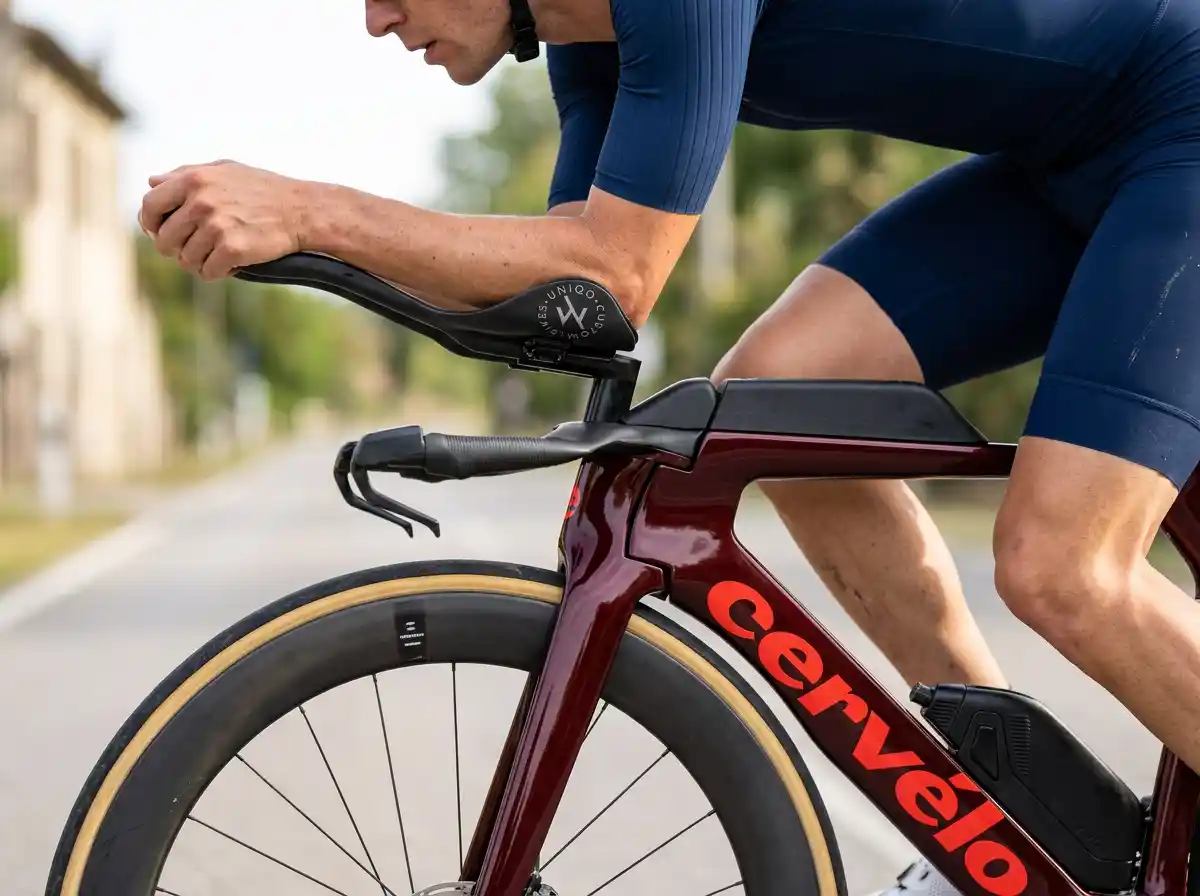
Brands such as WattShop, Predator or Spain's Uniqo are creating tailor-made solutions for athletes around the world.
The process is fascinating: they measure the athlete, design specific couplings for his anatomy and position, send him a 3D printed prototype to test it and, only when the fit is perfect, manufacture the final version in carbon fibre.
Case study: is it worth investing €2,000 in a cockpit?
This is where it gets serious for the pocket. Brands like New Zealand's FastTT are gaining enormous popularity with full cockpit systems hovering around €1,800-2,000.
Your Complete Cockpit Combo is a top-quality carbon base handlebar and coupling system, designed to be compatible with any standard 31.8mm power output.
And this, for you, is key. It means you don't need to buy a €12,000 bike to have a professional level front.
As pointed out in an analysis of the specialised website Slowtwitch, you can take a mid-high range bike such as a Cervélo P-Series, invest in such a cockpit and achieve aerodynamic performance and a fit very close to that of a P5, which costs €6,000 more.
It is the million dollar question: do I invest in a new painting or do I enhance the one I already have?
However, here too we must be honest and critical. These systems often use 3D printed parts for components such as hydration mounts.
FastTT's Big Kahuna Twin BTA Kit, for example, uses 3D parts for its double drum tower. And here there are reasonable doubts about durability.
As Slowtwitch critic Eric Wynn noted after testing it, “I should point out that most are lightweight 3D printed parts and I'm still not sure what to think about it… I'd rather the tower be machined aluminum or carbon.”
It's an important point: the lightness and customization of 3D can sometimes clash with the pump-proof robustness we demand from our material.
The Planet Endurance Verdict: Is 3D Printing for You?
After a thorough analysis, our conclusion is clear: 3D printing is not a fad. It is a very powerful manufacturing tool that has come to solve real problems of triathletes.
But, like any tool, you have to know when to use it.
When is it worth it? If you have a specific adjustment problem that you have not been able to solve with conventional material (pain in the saddle over long distances, hand numbness, inability to find a comfortable and aero position at the same time), a tailored solution, even if it is more expensive, may be the best investment you make.
It will allow you to train more and better, and enjoy each competition more.
When is it a luxury? If your current setup works well for you and you don't have significant discomfort, jumping to the most expensive 3D material on the market will probably give you a marginal profit.
You may scratch a few watts, but the cost-benefit ratio may not be ideal for a popular one.
What is certain is that technology is becoming cheaper and more democratic. What we see today in "halo" products of more than €2,000, in a few years will be the standard in much more accessible ranges.
In the end, the best technology is the one that allows you to train and compete without pain, with more desire and, why not, a little faster. And in that equation, 3D printing has come to add up. And a lot.