
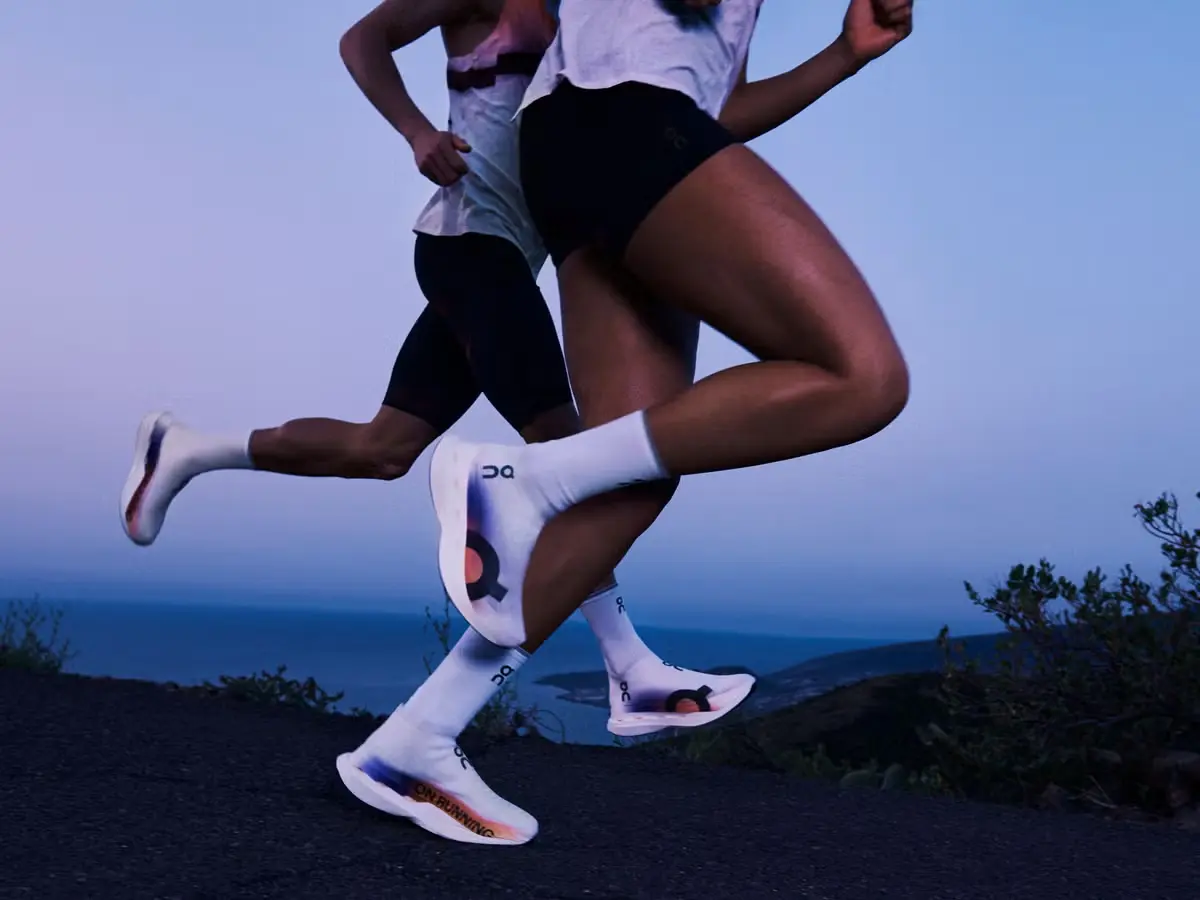
The 2025 New York Marathon ended with 59,226 people crossing the finish line. It is the largest marathon that has ever been run. That number alone doesn't explain much. The interesting thing is who ran it: more and more young people.
And as that figure went up, another went down at the same time at another point on the map. The luxury market was losing customers at a rate not seen for fifteen years. The two things are connected, and understand why it forces us to talk about shoes, bags and what it means to look like today.
The bag is dead, long live the bib
For decades, teaching status consisted of carrying around an expensive, recognizable object. A bag from a well-known firm, a garment with an identifiable logo.
For people born between the late 1990s and early 2010s, that no longer works the same. The indicator of success has shifted to another place: the body, health and what can be taught in networks about one's physical performance.
Training for a marathon and telling about it today gives more prestige in networks than buying a designer item. Wearing technical clothing from brands such as Alo Yoga, Lululemon or On communicates more than a haute couture garment. The storefront has moved.
The data from the New York Marathon shows this clearly. In 2022, runners under the age of 30 were 17% of those who finished the race. In 2025 they were already 24%.
The 25-29 age group became the largest group in the entire race, with almost 11,000 runners, more than a thousand above any other five-year stretch. Compared to a decade ago, men aged 18 to 29 who finished their degree increased by 86%. Women of the same age, 91%.
There is an economic reason behind this change. Young people in their twenties have encountered inflation, expensive housing, unstable work, and difficulty saving. The answer has not been to stop spending, but to spend in another way. 72% of the world's consumers say they have exchanged expensive products for cheaper alternatives.
Hence the rise of dupes, legal imitations of high-end products: 71% of Generation Z and 67% of Millennials use them, and those who buy them present it as knowing how to spend well, not how to settle.
There's one more reason, and it's not economical. Amid an epidemic of loneliness and screen time, running clubs and gyms have become places where people meet other people in person.
Spending on boutique fitness studios - Pilates classes, indoor cycling, high-intensity training in nursing homes - has skyrocketed. Each member pays between 110 and 125 euros a month, twice as much as a normal gym, which moves between 40 and 60 euros. That market moved 43.1 billion euros in 2024 and is estimated to grow by 8.2% a year to reach 69 billion in 2030.
Traditional luxury shrinks
Meanwhile, personal luxury entered 2025 in its first non-pandemic slump in fifteen years. The market lost around 20 million active customers.
It went from 400 million buyers in 2022 to 330 million in 2025. It is a 15% contraction in three years, and leaves the sector with the size it was in 2013.
That loss was not evenly spread. He focused almost entirely on the so-called “aspirational” buyer: the one who spends less than 5,000 euros a year on luxury. That profile represented 75% of the market in 2010. By 2025 it had dropped to 60%. That is, the customer who hangs up is precisely the young man who previously entered the brand through the small door, buying the most affordable item. That front door is empty.
Firms such as Gucci or Louis Vuitton have long been trying to bring new generations back to their physical stores, with mixed results.
The young customer they would have picked up before is now somewhere else, and part of that site has a Swiss brand behind it.
On sells expensive and never lowers
On Holding AG closed its 2025 fiscal year with more than 3,014 million Swiss francs in sales. This represents a growth of 30% compared to the previous year, or 35.6% if the effect of exchange rates is discounted.
It's the fastest growing sports brand in the world right now.
The data that should be looked at is not that of growth, but that of how money earns. On does not make discounts on its direct sales channels. Does not participate in Black Friday or discount campaigns.
When you have a surplus of shoes from a previous season, you don't spoil it: you keep it in a closed section of your website, which is only accessed with a registered user account. The old product leaves the main catalogue without anyone seeing a discounted shoe.
That decision has a measurable consequence. For every 100 francs that On enters selling, he has 62.8 left before deducting other expenses. This is called gross margin, and in 2025 it was the highest in the company's history: it rose from 60.6% the previous year, reached 63.9% in the last quarter and continued to rise at the beginning of 2026 to 64.2%.
To understand if that figure is high, you have to compare it. Nike closed its year with a gross margin of 42.7%, and saw it fall to 40.16% in the quarter ended February 2026, dragged down by a rigid cost structure and its reliance on promotions to empty warehouses.
Lululemon, which plays in the high end, was down to 56.6%.
The reference that On has close by is not a sports brand: it is Hermès, the French luxury house, which reported a gross margin of 71.1%. A brand of running shoes makes money with a mechanic more like that of a luxury bag than that of its direct competition.
The third element is where the product is sold. For years, On has refused to enter multi-brand stores that did not meet its conditions of service and presentation.
He purposely limited his presence in stores so as not to lose control over how the brand was displayed. In 2025, its direct-to-consumer sales channel grew by 33.7% to 1,260.5 million francs, and the wholesale channel -selling to other stores- remained at 1,753.4 million francs.
On does not abandon the wholesaler, it uses it to reach new customers, but it is reducing its traditional points of sale in Europe and the Middle East and replacing them with a network of almost 70 own stores in urban areas, open by the end of 2025.
Added to this is a makeover. On has combined its manufacturing technology with a design direction closer to fashion than to sport. The brand works with actress Zendaya and her creative director, Law Roach.
His 2025 spring campaign, photographed by Nadia Lee Cohen, was set in a fictional space station, with neutral colors and still compositions, without athletes sweating or scenes of effort.
On April 9, 2026, he presented his first collection of clothing and footwear created together with Zendaya, accompanied by a short film directed by Spike Jonze.
Clothing, which was a smaller part of the business in On, grew by 68.2% in 2025 to 169.9 million francs. Accessories grew 124.1%. Between the two areas, they account for 7% of the group's sales.
When luxury opens cafes
Traditional luxury brands have seen the young customer leave and have reacted by trying to occupy other spaces. One of his answers is what has been called “edible luxury”: opening cafes, pastry shops and restaurants inside their stores or in department stores.
The idea is to offer a cheap way to get in touch with the brand. A young man who cannot afford a bag can afford a coffee with the logo drawn on the foam.
Examples are scattered around the world. Prada has coffee shops in Harrods in London and Ion Orchard in Singapore, as well as the Italian patisserie Marchesi in Milan. Louis Vuitton has a chocolate shop and coffee shop by the hand of pastry chef Maxime Frédéric at the Cheval Blanc hotel in Paris. Burberry set up a temporary coffee shop in London during fashion week. Coach has a restaurant and cafe in Singapore.
These spaces lengthen the time the customer spends inside the store and generate content for social networks. In the case of Prada, its coffee shops can boost sales of other products by up to 130%.
Luxury has also approached sport through sponsorship. The LVMH group has invested more than $300 million in sponsoring Formula 1, equipping Real Madrid and signing young Olympic athletes.
It is a way to buy presence in the field where the client who has escaped is.
But now what?
The definition of luxury has changed. Traditional brands no longer have a monopoly on what is desirable. The young buyer has shifted their spending to a field - that of sport and well-being - where firms such as On or Alo Yoga now take the place of status.
On arrives at that place with three concrete decisions: not to sell the product, to control where it is sold and to maintain a coherent image. They are not flashy or noisy decisions.
They are the same ones that a luxury house applies, transferred to a brand of running shoes. By 2026, On expects to grow at least 23% at constant exchange rates, which would lead it to bill at least CHF 3,510 million.
Traditional luxury tries to retain the young customer with coffee shops and sports sponsorships. On does not need to approach the sport because it is already inside. That's the position the market is in today: luxury opens cafes to look accessible, while a running brand makes money as if selling handbags.