
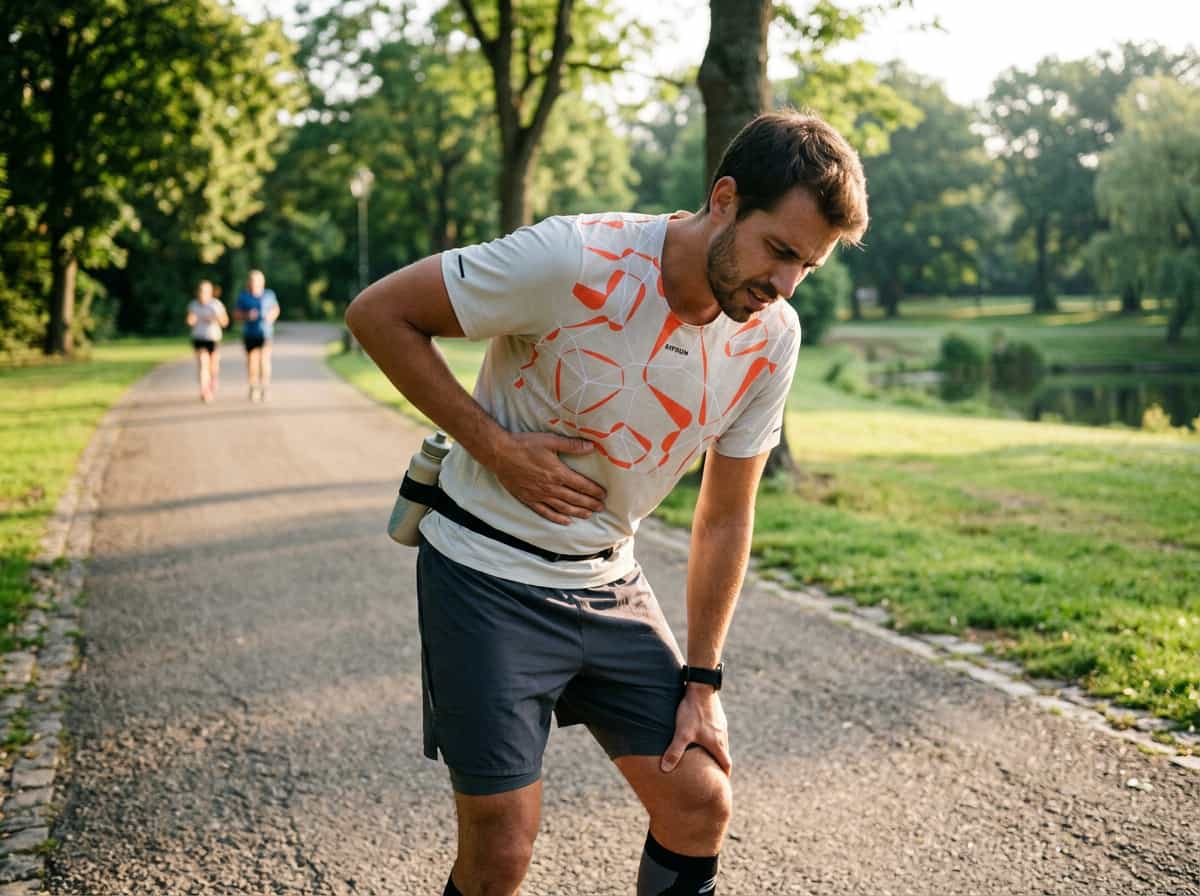
Let's see if you feel identified: you haven't run for a week with a fever, mucus and the couch as the main office. One day you wake up and you finally feel like a person. You go out to shoot with the best intention in the world and after ten minutes it appears: the flato, that twinge in your side that bends you and leaves you looking at the ground.
Your body is warning you: it has just come out of a war and is not for training.
What is Flato
The technical term is ETAP: transient abdominal pain associated with exercise. There is no absolute scientific consensus on its cause, but the most accepted theory points to irritation of the parietal peritoneum.
To understand it: your internal organs -stomach, liver, spleen- are wrapped in a membrane called the visceral peritoneum, and the abdominal cavity is covered inside by another, the parietal peritoneum. Between them there is a liquid that allows everything to slide smoothly when you move.
When you run, the repetitive impact causes the organs to shift and collide against the abdominal wall. If you add a full stomach, hectic breathing or other factors that increase friction, the parietal peritoneum becomes irritated and pain appears.
The other hypothesis, complementary to the previous one, points directly to the diaphragm. This dome-shaped muscle is primarily responsible for breathing and, under overexertion or poor respiratory mechanics, can suffer cramp-like spasms. The result is the same: that characteristic puncture in the side.
Why does he appear flatus just upon returning from an illness
It's no coincidence or bad luck. After an infection, the body presents a combination of factors that create the perfect setting for flatus. All at once.
The diaphragm has been working piecewise for days
When you've been through a cold, flu, or any respiratory infection, you've been coughing, sneezing, and breathing with partially obstructed airways. That, although it may not seem like it, is a high-intensity workout for the diaphragm and intercostal muscles. They have been working tirelessly for days to expel mucus and keep the air circulating. They are fatigued, tense and weakened.
When you go for a run, you suddenly ask them to withstand a much higher oxygen demand. A fatigued muscle that requires intense effort is a direct candidate for spasm. It's the same logic as a twin cramp, but applied to the main muscle of your breath, at the worst possible time.
Dehydration and electrolyte imbalance
Fighting an infection is resource-intensive, and fluids are the first to suffer. If you have had a fever, your body has sweated to regulate the temperature and has lost water and mineral salts -sodium, potassium- in the process. In addition, during an illness you eat and drink much less than usual.
The consequences are direct: even mild dehydration reduces the volume of circulating blood. Less blood means less oxygen reaching the muscles, including the diaphragm. And a poorly oxygenated muscle is a muscle prone to cramping. Electrolyte imbalance aggravates the problem because they are essential for muscle contraction and relaxation to function normally.
The digestive system, altered and sensitive
Any systemic disease affects the digestive system. The infection itself or the medication - mainly anti-inflammatory - can alter intestinal motility and leave the stomach and intestines in a state of greater irritability.
When starting to run, the body diverts blood flow from the internal organs to the muscles that are working, mainly the legs.
If the digestive system was already sensitive, that “theft” of blood irritates it even more. A bowel or stomach in that state more easily presses on and irritates the parietal peritoneum, triggering flatus. It's the same principle that explains why flatness appears when you run right after eating, but amplified by post-disease sensitivity.
Energy reserves, low minimums
The immune system needs an enormous amount of energy to fight pathogens, and it takes it mainly from glycogen: the fuel stored in muscles and liver. During sick days, your body has been pulling on those reserves to win the internal battle.

When you go for a run, the deposits are probably not even fifty percent. Running on low fuel forces the body to work less efficiently, which triggers the heart and respiratory rate earlier. That rapid and shallow breathing that appears much earlier than usual is one of the most direct triggers of flatus.
The rush to make up for lost time
After days of standing, it is normal to feel a mixture of desire and anxiety. That rush leads to going out at a higher rate than the body can handle at the time. Too high a rhythm generates shallow, chest breathing, which overloads the accessory muscles of the neck and chest and does not use the diaphragm throughout its range. The result is a diaphragm that works in unfavorable conditions and with an increased risk of spasm.
The circle closes itself: you get overwhelmed by going slow, you accelerate, you breathe worse, flatus appears, you get frustrated and the situation gets worse. Managing this comeback is both a physical and mental challenge.
Before Departure
Proactive hydration throughout the day, not just in the run-up to departure. If you have had a fever for several days and have sweated a lot, consider also replenishing electrolytes with an isotonic drink, not just water. Wait at least two to three hours after the last main meal before leaving. If you want to have something light just before, that is easy to digest and low in fat and fiber: a banana or toast with jam forty-five minutes
Spend five minutes before starting to activate the diaphragm. Standing, inhale through your nose for four seconds letting your abdomen expand - your chest should move little - hold the air for two seconds and exhale slowly through your mouth for six, as if you were blowing out a candle, feeling the navel approach the spine. Ten or fifteen repetitions. It may seem unnecessary to someone who has been running for years, but right now the di
During Race
The first day has no goal of pace or distance. The only criterion is to finish without pain. Start at a pace that you find ridiculously conservative, one where you can have a conversation without gasping. If the body asks for more, wait. If necessary, use the method of alternating running and walking: five minutes of gentle running, two minutes of walking, and repeat.
Keep your abdominal breathing and try to give it rhythm. Synchronizing it with the stride helps avoid chaotic breathing: three steps inhaling, three exhaling. When the respiratory mechanics are broken, the flatus appears more easily.
If the pain shows up anyway, don't ignore it or try to run through it. Reduce intensity immediately or stop walking. Press the area with your fingers applying firm but gentle pressure as you exhale. Raise your arm on the affected side above your head and lean slightly to the opposite side to stretch your side. A long, forced exhalation with pursed lips helps relax the diaphragm. Wait
After the race
Recovery begins in the first hour. Drink water or isotonic and drink something with carbohydrates and protein to start replenishing the reserves that the disease left empty. This sets the stage for the next outing to be better.
If you've only managed fifteen minutes without flatus on the first day, it's a good first day. Don't try to do forty-five the next day. The progression has to be very gradual: ten or fifteen percent more volume at most at each exit. The post-disease body needs small stimuli and time to adjust, not an accelerated catch-up that pulls it back.
To close
The flatus in the post-disease return has a precise explanation for each of its fronts: the diaphragm has been tired of coughing and sneezing for days, electrolytes are low after fever, the digestive system is still altered by infection or medication, and glycogen reserves have been consumed fighting the virus.
Going for a run in that state and expecting everything to work normally is asking too much of the body too soon.
Pre-hydration, respecting digestion times, activating the diaphragm before starting, starting at a pace that seems insufficient and progressing slowly are the tools that prevent that stab in the side from ruining every attempt to return.
Every runner has gone through this at some point. Those who return well are those who understand that the return after an illness has its own times, and that forcing them is expensive.